
Inviting Iran Into the Solution
(Essay)

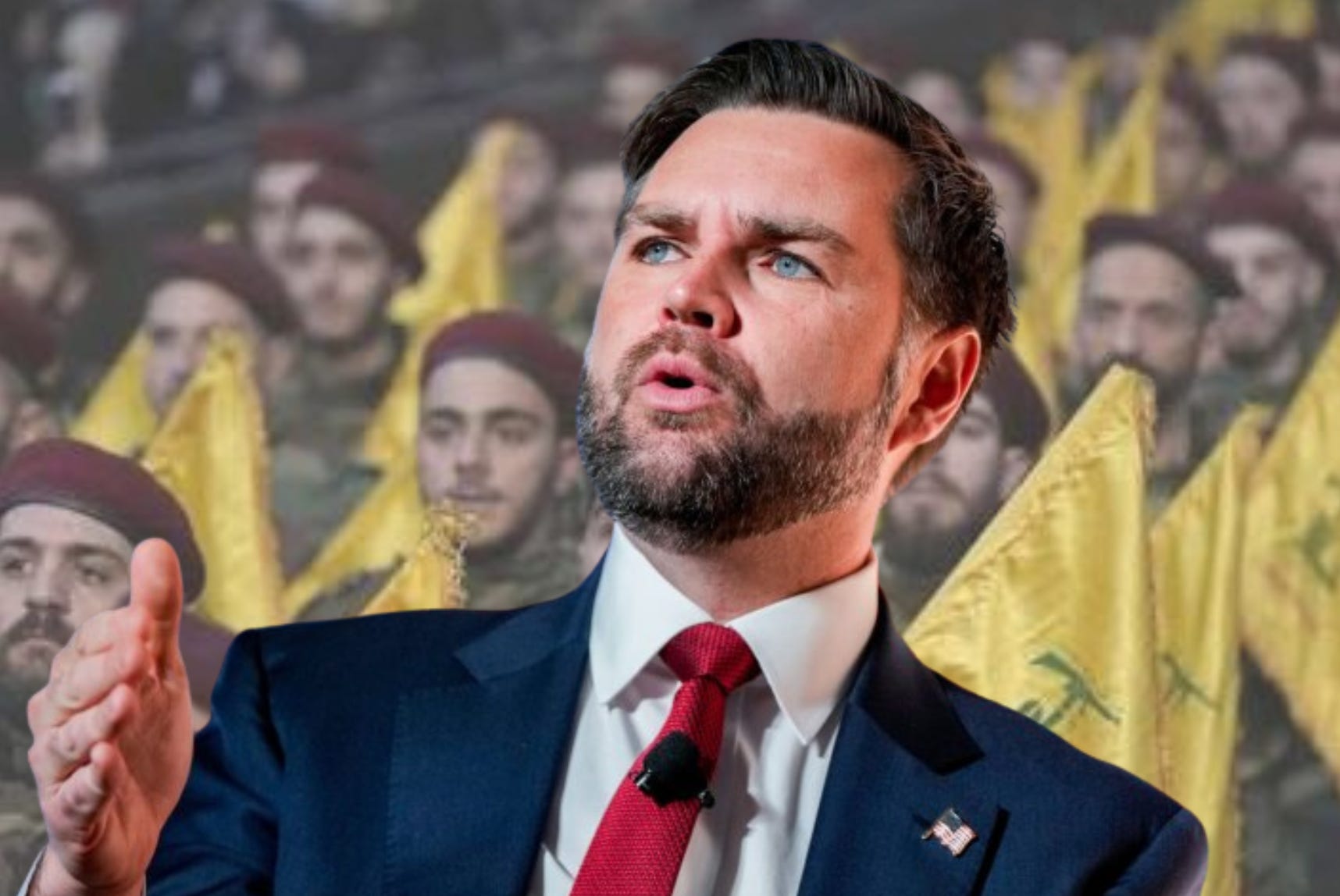
Decisions are never made by institutions.
They are made by people in rooms. Not gods or superhumans. People sitting around tables. People studying intelligence reports. People taking a brief break, checking in with a spouse, and then returning to the difficult work of weighing military realities against political constraints.
Vice President JD Vance sits in one such room now.
For a leader whose political identity is deeply rooted in a realist foreign policy—one explicitly designed to avoid the open-ended, costly entanglements of the past—the dilemma before him is uniquely agonizing.
Vance himself has spoken optimistically about the effort, saying that “very good progress” had been made toward a deconfliction mechanism and that negotiations had laid “a very good foundation for a successful final deal.”
His challenge is formidable. The United States wants to prevent a renewed war between Israel and Hezbollah. It wants to avoid a wider regional conflict. It wants to reduce the likelihood that American forces will once again become entangled in Middle Eastern hostilities. And it must achieve those objectives without committing itself to another exhausting military campaign.
These are serious goals. They are also extraordinarily difficult ones.
The war has been costly. Hezbollah has been weakened but not eliminated. Lebanon remains fragile. Iran remains influential. Everyone is searching for a way to reduce the likelihood of another conflict. It is not difficult to understand why a diplomatic framework—one inviting Iran to act as a guarantor and help manage the Hezbollah problem—might gain support in a room filled with serious people confronting a serious problem.
But here is the question that must be asked before this framework advances another inch:
Not whether Iran can restrain Hezbollah. Everyone knows it can.
The question is whether Iran has any meaningful incentive to do so.
Iran is not merely connected to the Hezbollah problem. Iran is the reason there is a Hezbollah problem.
The Islamic Republic created, financed, armed, trained, advised, and sustained Hezbollah for more than forty years. Hezbollah is not some unfortunate byproduct of Iranian foreign policy. It is one of its greatest successes—an instrument through which Tehran projects power into Lebanon, threatens Israel, challenges American interests, and extends its influence across the region.
Which is precisely why capability is the wrong question.
What pressure is being brought to bear on Tehran? What penalties follow if Hezbollah remains armed? What consequence follows if Iran signs an agreement, accepts the diplomatic benefits, and then proceeds exactly as it has proceeded for decades?
Diplomacy succeeds when incentives exist to change behavior. The public discussion thus far appears rich in inducements and remarkably thin on leverage.
There is another question worth asking.
What precedent supports this approach?
When has the Islamic Republic voluntarily dismantled a major instrument of regional influence because Western diplomats asked it to do so?
Iran created Hezbollah in the early 1980s. It spent decades nurturing it into one of the most heavily armed non-state forces in the world. It has funded and armed Hamas and Palestinian Islamic Jihad. It has supported Shiite militias throughout Iraq. It has backed the Houthis in Yemen. Across four decades and multiple administrations, the pattern has remained remarkably consistent. The regime builds leverage patiently and rarely surrenders it voluntarily.
That history does not prove diplomacy is impossible, but it does suggest that any proposal relying upon Iranian self-restraint deserves extraordinary scrutiny.
When confronted by an exceptionally difficult problem, people often become attracted to exceptionally convenient solutions. The desire to avoid another war is understandable. The search for a diplomatic off-ramp is entirely rational. However, a framework is not a strategy simply because it is preferable to the alternative.
The burden of proof rests with those advocating this policy.
They must explain not merely why Iran is capable of restraining Hezbollah, but why Iran would choose to weaken an organization it spent forty years building. They must explain why the sponsor of the militia should now be treated as a partner in managing it.
Skepticism about that proposition is not confined to Israel.
Lebanese President Joseph Aoun has repeatedly argued that Lebanon’s future depends upon restoring a monopoly on force to the Lebanese state. Other anti-Hezbollah Lebanese leaders have spent years making a similar case. For many Lebanese, the problem is not insufficient Iranian involvement in Lebanon.
The problem is decades of Iranian involvement in Lebanon. Israeli concerns arise from a different, though related, reality.
For Washington, stability may be the primary objective. For Israel, the objective is security. A superpower shielded by two oceans can sometimes tolerate arrangements that reduce violence without fully resolving underlying threats. A small nation facing a heavily armed Iranian proxy on its border cannot.
That difference reflects different circumstances. American policymakers are searching for a way to prevent another war. Israelis are asking whether the proposed solution leaves intact the very infrastructure that made the last war possible.
The people sitting around those tables are undoubtedly intelligent. They bear responsibilities most of us will never shoulder. Yet intelligence does not eliminate a basic human temptation: to prefer the answer that makes a problem feel solvable.
This proposal deserves harder scrutiny than that. Because until someone explains why Iran would voluntarily diminish one of the most successful instruments of power it has ever built, what is being offered is not a strategy.
It is a hope.
In the Middle East, hope has rarely been an adequate substitute for hard-nosed incentives.

8/20/26 The Dakota Minneapolis, MN Ticket Link
8/23/26 Space Evanston, IL Ticket Link
8/26/26 Drom NYC, NY Ticket Link

Diplomacy is not what (finally) put an end to Nazis and European fascism. And there is little difference between then and now in terms of the mentalities of the people were are dealing with.
No no no. The people around the table are not intelligent and not capable. Except for the Islamic regime of course. Trump went with a military option BECAUSE he recognized that negotiation was pointless. Now he is at the negotiation table as if the war never happened and he is surrendering American and Israeli interests. It's nuts.
There are two approaches to dealing with Iran.
1. Extreme sanctions and isolation in the hopes of weakening the regime.
2. Attack and eliminate the threat.
One was tried for decades. In February Trump decided to go with number 2. Then he inexplicably decided on 3, appease the regime and surrender a hard fought advantage for no reason while also turning on Israel.
Every day we spend spinning our wheels with the Mullahs is another day we grow weaker.