
What the West Fails to See: A View From an Observant Jew
Why my faith gives me insight into radical Islam that many Western leaders and commentators miss

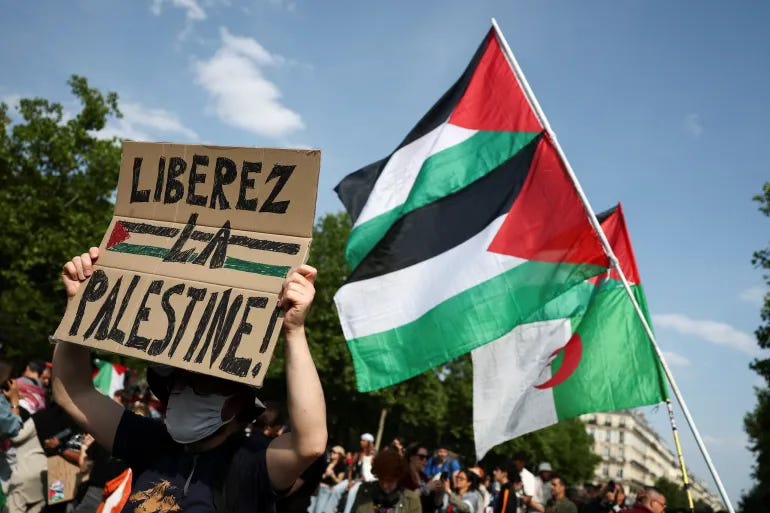
Protest Paris June, 2025
As an observant Jew who strives to live by the commandments of the Torah—a 3,300-year-old covenantal text, I believe I am more intuitively equipped than most Western journalists, academics, and politicians to perceive the worldview animating radical Islamist ideologies like those of Hamas, Hezbollah, the Muslim Brotherhood, and the Islamic Republic of Iran.
My faith roots me in a world where belief in God, a transcendent moral order, and an enduring soul are not quaint metaphors but foundations for living. Because of that, I sense in ways the pundits cannot —the fervor, the absolutism, the scriptures of death these movements summon. And I see how easily liberal frameworks fail to grasp them.
In a strange way, I feel a paradoxical kinship with those who commit themselves to radical Islam. Certainly not in the violence, but in the fact of holding a faith. Both of us resist the assumption that modernity is automatically good. Both reach back to an ancient past as a guide to the present. Both cherish peoplehood and tribe. Both believe in God and in the soul’s endurance. These affinities sharpen my empathy—never for a theology, which idealizes death, but for religious conviction itself—and they give me an advantage over Western commentators who imagine Hamas can be appeased with land swaps or treaties. In their naïveté and no small degree of hubris, many of these commentators simply cannot imagine a perspective that fundamentally precludes liberal modernism.
Those similarities between us only make the differences more decisive. The Torah itself does not shy away from difficult passages. After the Exodus from their enslavement in Egypt, the Israelites are commanded: “blot out the memory of Amalek” (Deut. 25:19); “show no mercy” to certain Canaanite nations (Deut. 7:1–2); the saga of Moab and Midian in Numbers 31. These commands are indeed parts of our text. Yet classical rabbinic tradition binds them in time and space—applied to identifiable peoples in a particular founding era, not indefinitely. Centuries of prophetic teaching—Isaiah’s vision of justice, Micah’s humility, Hosea’s mercy—permanently reoriented the Jewish moral imagination.
For millennia, Judaism has emphatically rejected forced conversion, genocide, and the killing of innocents. Every human being is b’tzelem Elokim, created in the image of God. There is no covenantal mandate to erase others. If Judaism ever demanded wanton murder, rape, or forced conversion, I would abandon it. But it does not. Its central command is life itself: “I have set before you life and death; choose life.”
Radical Islamist ideologies, by contrast, often valorize death. The Qurʾān contains verses extremists wield as divine sanction: “Do not think of those who are slain in the way of Allah as dead; they are alive with their Lord” (3:169); “Indeed, Allah has purchased from the believers their lives and their properties [in exchange] for Paradise. They fight in the cause of Allah, so they kill and are killed” (9:111). Supplement these with hadith traditions—some of contested authenticity but potently real to literalists—promising a martyr’s reward of bliss and eroticism: seventy-two companions of exquisite beauty, rivers of milk and honey, pleasures forbidden in this life.
Many mainstream Muslim scholars interpret these images as symbolic or weak, yet in ideological streams aligned with Hamas, ISIS, or hard-line Shiʿa readings, they are taken literally. Martyrdom is not tragedy—it is the supreme offering. Murder becomes sacrament. The difference is not rhetorical; it is existential. Where Torah says choose life, these doctrines, as we saw on 10/7/23, make death into worship.
This theological chasm is why so much of the Western political class misreads what is happening. They assume peace is a function of territory and “good-faith” negotiations. They treat recognition of Palestine as an act of moral clarity. Yet when the United Kingdom, Canada, France, and Australia recently recognized the “State of Palestine,” they acted as though that symbolic gesture addressed injustice rather than misread a deeper war of narratives. They imagined Palestinians as aggrieved partners in a diplomatic contest, refusing to believe that for the most powerful actors on the ground the goal is not negotiation but elimination. They fail—or refuse to see—that for Hamas this is a religious war.
Western theorists and diplomats compress religious and political motives into liberal categories—human rights, national self-determination, democracy. They speak of “justice,” “rights,” “occupation,” “settlements,” all valid words in the right context, but inadequate when the adversary rejects compromise, denies the legitimacy of the Jewish state, and treats the land itself as an irrevocable Islamic trust. They cannot conceive a perspective that places itself outside their frame. They treat radical Islamic ideology as pathology or distortion, rather than as a spiritual project with its own internal logic.
That failure has consequences. When Western states issue recognitions of Palestine, they congratulate themselves for moral courage while ignoring how such moves can be weaponized by extremists. They imagine recognition will empower moderates; they underplay how militant groups will exploit it. They assume humanitarian appeals or symbolic acts will shift hearts. Meanwhile, they ignore, or refuse to believe, that for many jihadists death in war is a preferred bridge to paradise, not a tragedy to avoid.
I can empathize with the religious intensity of such beliefs because, in certain respects, I live inside a similar covenant. I know what it is to have commandments that seem strange, inconvenient, even radical. I know what it is to defend faith against the tides of secularism. I understand how a transcendent ideal can demand a kind of spiritual self-sacrifice. But that same covenant absolutely forbids me to kill innocents or to demand that others convert or perish. It commands life—always. That is my dividing line.
The kinship I feel with devout Muslims—the reverence for the past, the conviction that life has eternal meaning—only heightens the divergence. Faith can elevate or degrade, sanctify or desecrate. It is not belief in God that divides us but the way God is imagined, the way scripture is weaponized or honored.
To face this reality is not to abandon empathy; it is to refuse fantasy. Diplomacy and recognition remain valuable tools, but they cannot substitute for moral clarity rooted in an unsentimental understanding of what radical ideologies seek. The Western world will keep failing until it grasps that truth—until it sees that ideology is not a policy glitch but a competing cosmos.
I pray for true and lasting peace. I also pray for a revival of Islam’s own traditions of mercy and justice—an internal reclaiming of God’s name from the cult of death. Until that day, realism in moral, linguistic, and political terms remains the only kind of empathy that can preserve life.
I first read this on Facebook yesterday, and I have shared links to that post at least half a dozen times, because what you are pointing to here is waaaaay too often overlooked. Thank you, thank you, thank you!
This is so well written and such courageous clarity, not without compassion. Thank you.