
What Rhetoric Permits
On the Minneapolis Protests, the 1930s, and the Line We May No Longer See

I’m Minnesota-born and bred. I carry the state inside me with great pride. I went to school there, learned to understand its people, learned to play music, learned to love a place. Who couldn’t love the land of sky-blue waters—and of course that gem, Minneapolis, the city of lakes?
In recent weeks, I’ve heard people advocating for a curious and alarming idea: that people who are legal to carry firearms should bring them to protests. It has been framed as protection, a kind of guarding of constitutional space. Some have greeted that stance as courageous, even heroic. I find it frightening.
At first glance, the argument feels understandable: concern about safety when large numbers of people gather, a justifiable distrust in institutions, a desire to be prepared for any eventuality. But once you pause long enough to consider the historical weight behind the language we use, it changes things. At least it does for me.
This is the concern I want to anchor at the center of this conversation: not the refusal to be shamed or forced into silence (that is a sacred civic right and instinct), but the ease with which words slip into justifying violence, and the speed with which societies fracture once that line is crossed.
Words, as I’ve written many times and in many ways, aren’t inert. They carry histories. They carry permission. They carry momentum. While legal in Minnesota (and it’s worth noting how those who once vehemently decried concealed-carry laws are suddenly supporting them), bringing a loaded firearm to a protest is no longer an abstract expression of rights. It becomes a lived possibility of injury, escalation, fear, accident, retaliation.
Reading a well-written essay a few days ago, I found myself returning to a question it raised. There was talk of Nazis, Hitler, the Gestapo, and the approval of using those terms. I abhor their appropriation for reasons too obvious to mention. But if we invoke the language of the 1930s in this instance—a murderous decade that culminated in the murder of six million Jews—then we also have to ask what that language historically demanded of us. Not outrage. Not peaceful protest. Not even civil disobedience. That language, in its full context, carried with it the rhetoric of violent resistance, sabotage, and the overthrow of governments. In the 1930s, this became what I would consider morally sanctioned advocacy for actual violence. My question is simple: is that morally advocatable now?
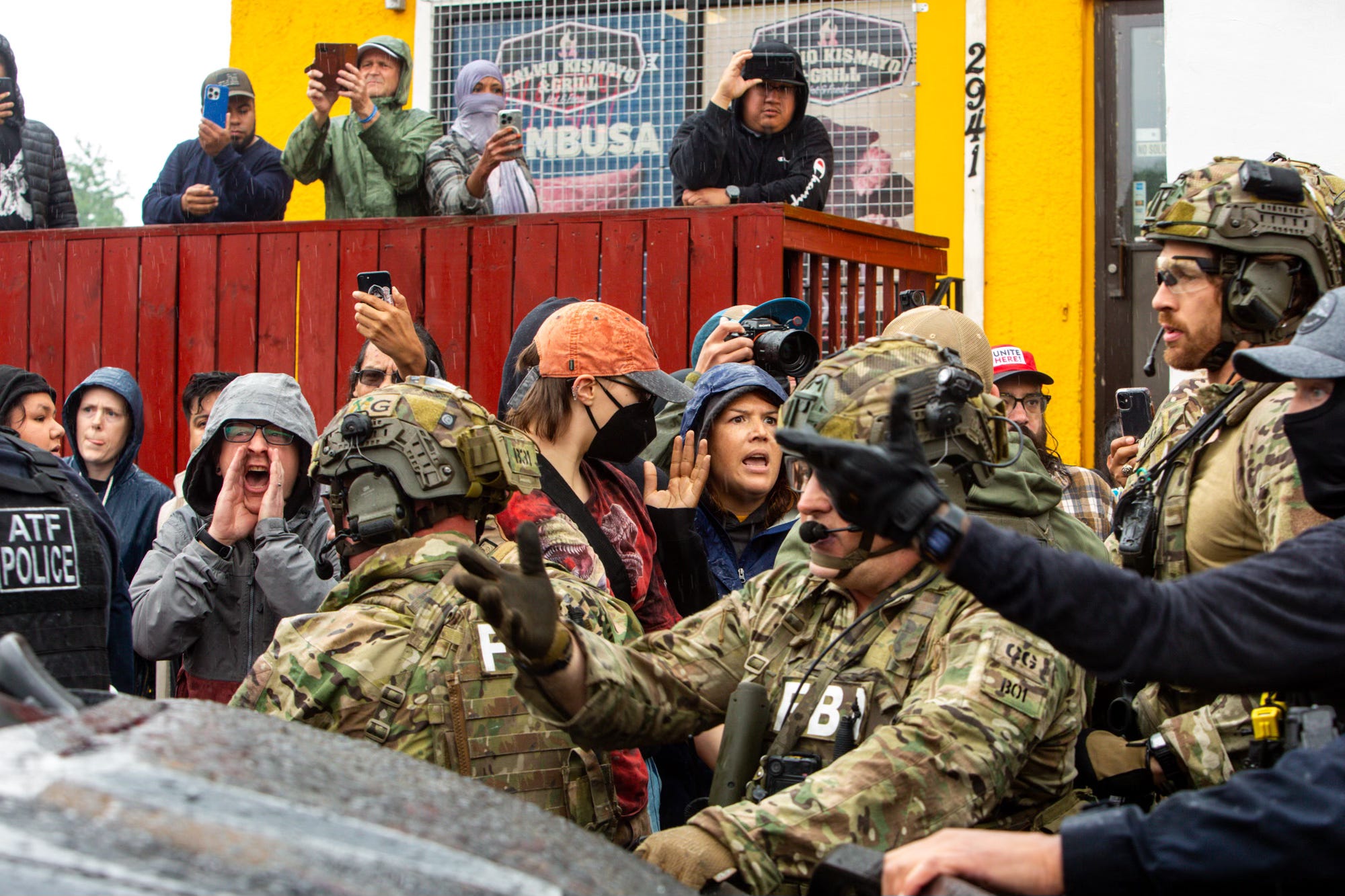
I understand the frustration with our polarized politics and the breakdown of trust in the institutions meant to preserve public safety. I understand the harm caused by having hundreds of undertrained federal agents roaming the same streets I once walked down, in what is often a brutal, divisive, callous—and, as we’ve seen, deadly—Trump-led strategy to deport undocumented people. And I also understand that holding arms, even legally, at protests is a threshold. It is a choice to invite instruments of harm into spaces of disagreement. It is a call to others to do the same. And once that dangerous threshold is crossed—even rhetorically—we find ourselves on a slippery slope. In doing so, we tell ourselves we are protecting peace, but we risk making violence the default backdrop of dissent.
I read this today in The Atlantic: “Minnesota governor Tim Walz worries that the violence in his state could produce a national rupture. ‘I mean, is this a Fort Sumter?’ he mused today in an interview in his office at the state capitol.” The island fortification near Charleston, South Carolina, is where Confederate forces fired the first shots of the Civil War in 1861. Now it is federal forces that are risking a breach. “It’s a physical assault,” Walz said. “It’s an armed force that’s assaulting, that’s killing my constituents, my citizens.”
History, if we study it, contains the means to make us wise. Not simply cautious, but deliberately vigilant about our language—how we use it, how we inherit it, and how easily it can be repurposed to mean something we never intended. To invoke the 1930s is to introduce something heavier than we may realize. If it isn’t merely an overwrought metaphor, but something real—a real “Nazi invasion”—should people not be prepared to trace it all the way through? Not only the comfortable parts, but the uncomfortable ones too: the violence, the fractures, the undoing of social bonds that come when actual war ensues.
I call for ICE to immediately redraft its evident ineffectual and polarizing strategy. I call for those who insist on further weaponizing this conflict to reconsider their motives. I do not call for silence, but for a commensurate recognition that the line between defending rights and defending territory with force is thinner and more dangerous than many of us realize. I worry about that ease of slide. I fear what it might do to the fragile bonds, no stronger than gossamer, that hold democratic life together.
And I believe, deeply, that our words, and the choices they inform, should aim not to fracture, but to expand our shared sense of humanity.
A few random thoughts on Minnesota:
1) In Germany after WWII, approximately 200,000 Jews (including my mother's family) were housed in displaced persons camps at any given time. They were treated humanely and housed in family units. In the US today, roughly 70,000 people are in ICE detention facilities at any given time, are subject to inhumane treatment and are routinely separated from family members. Why can't the US treat a relatively small number of illegal immigrants with dignity? Because our government wants to make an example of them? No, they're not concentration camps, but surely we should treat people in unfortunate circumstances with basic humanity. And our congresspeople should be able to monitor the detention centers without undue obstacles UNLESS ICE HAS SOMETHING TO HIDE.
2) For the life of me, I can't understand what Alex Pretti hoped to accomplish by bringing a gun with him to protest ICE. Under what circumstances would he have drawn the weapon? Since he did not draw the weapon and was carrying it legally, it has no bearing on his murder by ICE officers, but I do wonder. He had it in the video taken 11 days earlier as well, so it was not a response to that incident.
3) Yes, murder. He was shot in the back while on all fours on the ground, completely helpless. Then he was shot 4 more times while lying motionless, face up. That is murder in my book. Under normal circumstances, a public trial would offer the officers who shot him an opportunity to explain and defend their actions. Anything less is a miscarriage of justice.
4) Did Pretti really have two extra magazines with him? I have not seen them in any of the bystander video or photos released by the administration. Was that another piece of Trump-era propaganda, or alternative facts, designed to smear a political opponent? If it was true, why not show the evidence?
Well put as always. There are so many things that are thought to be true that aren't. Ice is not a Gestapo or an illegal army. It is a federal force designed to detain potentially dangerous illegal immigrants. Ice is NOT trained in crowd control. That is not part of its mission. The local governments by withholding police to control the street and keep protesters from the federal officers are derelict in their duty. At this point knowing that the local government will withhold police means the federal government, is also derelict in its duty. It must provide ICE with police protection.
The people who are confronting ICE physically are not protesters. They are not exercising first amendment rights. They are committing criminal acts. Protesting would involve standing 100 yards away and holding signs and chanting. This is most certainly not what is happening. The people they are protecting are not innocent Jews being hounded by Nazis. They are not innocent black people being menaced by the KKK. They are at best people with no legal right to be here and at worst, convicted criminals, some dangerous.
The local governments that are both allowing this kind of potentially violent obstruction both by withholding crowd control and by issuing incendiary rhetoric are morally if not legally complict in all of this. The private radical organizations that are funding these things are looking for violence and they are using potentially well meaning people and in some cases troubled people as bait.
In places where local authorities provide crowd control, nobody is dying.
This is reality and if it is not acknowledged there is no common language to discuss next steps.