
Improbable Sunday: Why Treating the World as "Ordinary" is an Error in Perception
(Essay)

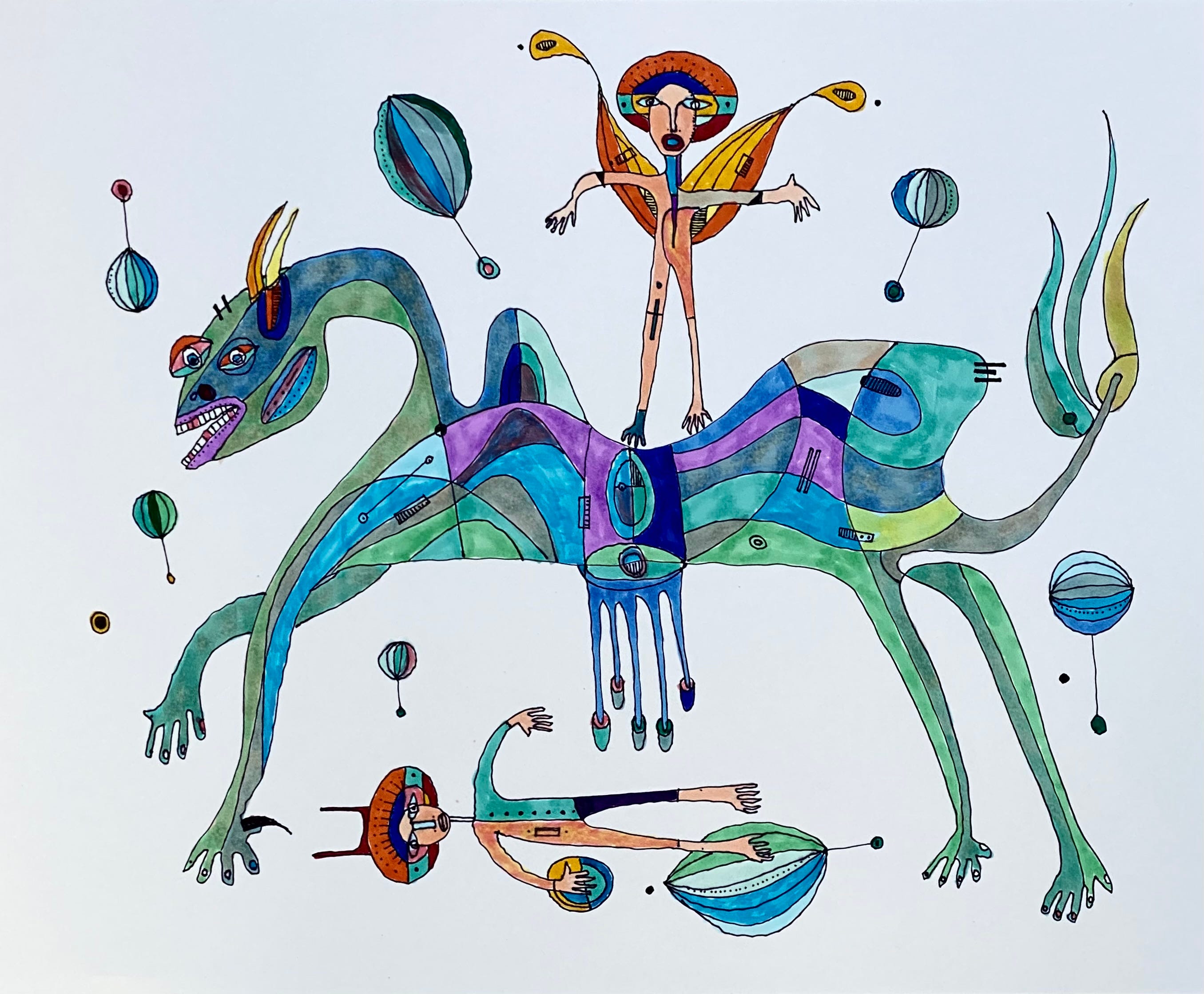
“Ya Ya Koo Koo” (Ink and watercolor marker on paper 14”x17”) Drawing by the author
This morning, as often happens in these days, I woke before I intended to. And as I lay there, before the obligations of the day began announcing themselves, I found myself again considering the strange fact that I exist. Not merely that I’m alive. The Japanese elms outside my window are alive. The small gray birds for which I have no name are alive. The neighbor’s dog whose bark is our alarm clock is alive. I mean that there is, somehow, one small center of awareness from which the universe is presently being observed, and that center happens to be me.
It’s a difficult thing to consider, given that my own awareness—and though I can’t know for certain, I suspect everyone else’s is as well—is so commonplace that it’s nearly impossible to separate it from the ordinary view of the world and examine its sheer unlikelihood. We awaken every morning into ourselves so effortlessly that familiarity becomes inevitability. It’s as though the most astonishing fact of our existence has become invisible precisely because it is always with us.
And what of such an exercise on a Sunday morning? What possible purpose could it serve when there are phone calls to return, a practice schedule to keep, airline reservations to make, breakfast to eat? If I had to describe its purpose, it would not be to persuade myself of the supernatural. Quite the opposite. It would be to remind myself of reality. To reclaim accuracy. To note, however briefly, the plain fact that reality itself is far stranger than I ordinarily allow myself to notice.
Most of us know, at least in passing, the argument about our own improbability. My parents had to meet. They had to remain together. The exact sperm had to meet the exact egg. Their parents had to meet. And theirs before them. Stretch the chain backward through every generation—to wars narrowly survived, illnesses overcome, migrations undertaken, accidents avoided, chance encounters that almost never happened—and one begins to realize that every ancestor represents another impossibility successfully navigated. Had any one of those countless moments turned out differently, someone might have existed. It simply wouldn’t have been me.
Being human, we’ve naturally tried to put numbers to all this. One widely cited estimate puts the odds of your particular ancestral chain—stretching back roughly 150,000 generations, driven by that single winning sperm meeting that single egg generation after generation—at something like one in 10^45,000. By comparison, the estimated number of atoms in the observable universe is “only” about 10^80. The ancestral odds are a 1 followed by 45,000 zeros. Written out by hand at ordinary type size, that string of zeros alone would stretch the length of a football field. And that’s only one attempt to calculate the improbability of your existence. Numbers like these quickly stop illuminating anything at all. Yet that, perhaps, is precisely the point. The mathematics eventually outruns imagination. The probability of our particular existence becomes so vanishingly small that language itself begins to fail.
And then the lens widens again.
Our existence depended not only upon an uninterrupted chain of ancestors, but upon life existing in the first place. Physicists tell us that if gravity had been only slightly different, stars capable of forging the elements necessary for life would never have formed. If the strong nuclear force had varied by the smallest amount, there would be no stable atoms. If the universe had expanded a little faster, matter would never have gathered into galaxies. A little slower, and it would have collapsed back upon itself before stars could ignite. Roger Penrose calculated the odds against the universe’s extraordinarily low-entropy starting condition at a number so vast that writing out its zeroes would require more digits than there are particles in the observable universe.
Astronomer Hugh Ross compared the likelihood of such fine-tuning arising by chance to the possibility of a Boeing 747 being completely assembled as the result of a tornado striking a junkyard. It is a marvelous metaphor, not because it proves anything, but because it reminds us how poorly our intuitions grasp improbability.
And yet here we are. Not merely living, but wondering. Loving. Making music. Arguing. Praying. And sometimes standing in front of the pantry wondering what it was we came there to find.
The temptation is to call all of this miraculous. But I wonder whether that word has become misleading. For many, miracle suggests a suspension of natural laws, an interruption in the ordinary workings of the world. I find myself thinking almost the opposite. It’s not that the improbable occasionally breaks through the ordinary; it’s that the ordinary was improbable all along, and we simply stopped noticing. The ordinariness of the world is the astonishing thing.
What I’m after isn’t a feeling. It’s accuracy. Wonder comes and goes. It is an emotion. Accuracy asks only that I see the world more truthfully. I see it as a quest to normalize my own sense of the world. Not simply to include the possibility of miraculousness—or perhaps a better word would be sanctity—but to move it from the sidelines and place it where it belongs: at the center of my understanding of reality. Because if existence truly is this unlikely, then walking through life as though everything were ordinary is a perceptual error.
Perhaps this, too, is the nature of prayer. Not escaping reality, but correcting our perception of it. Reframing one’s conception of the world from something circumscribed, random, and ultimately indifferent into a place overflowing with mystery and possibility—a world in which every conversation, every kindness, every song, every grandchild, every ordinary Sunday morning unfolds against a backdrop so improbable that the only honest response may be gratitude. Memory of this kind, held onto rather than visited once and set down, tends naturally toward gratitude, the way sustained attention to any gift eventually does.
The world has always been this astonishing. The only thing that changes is whether we remember it.
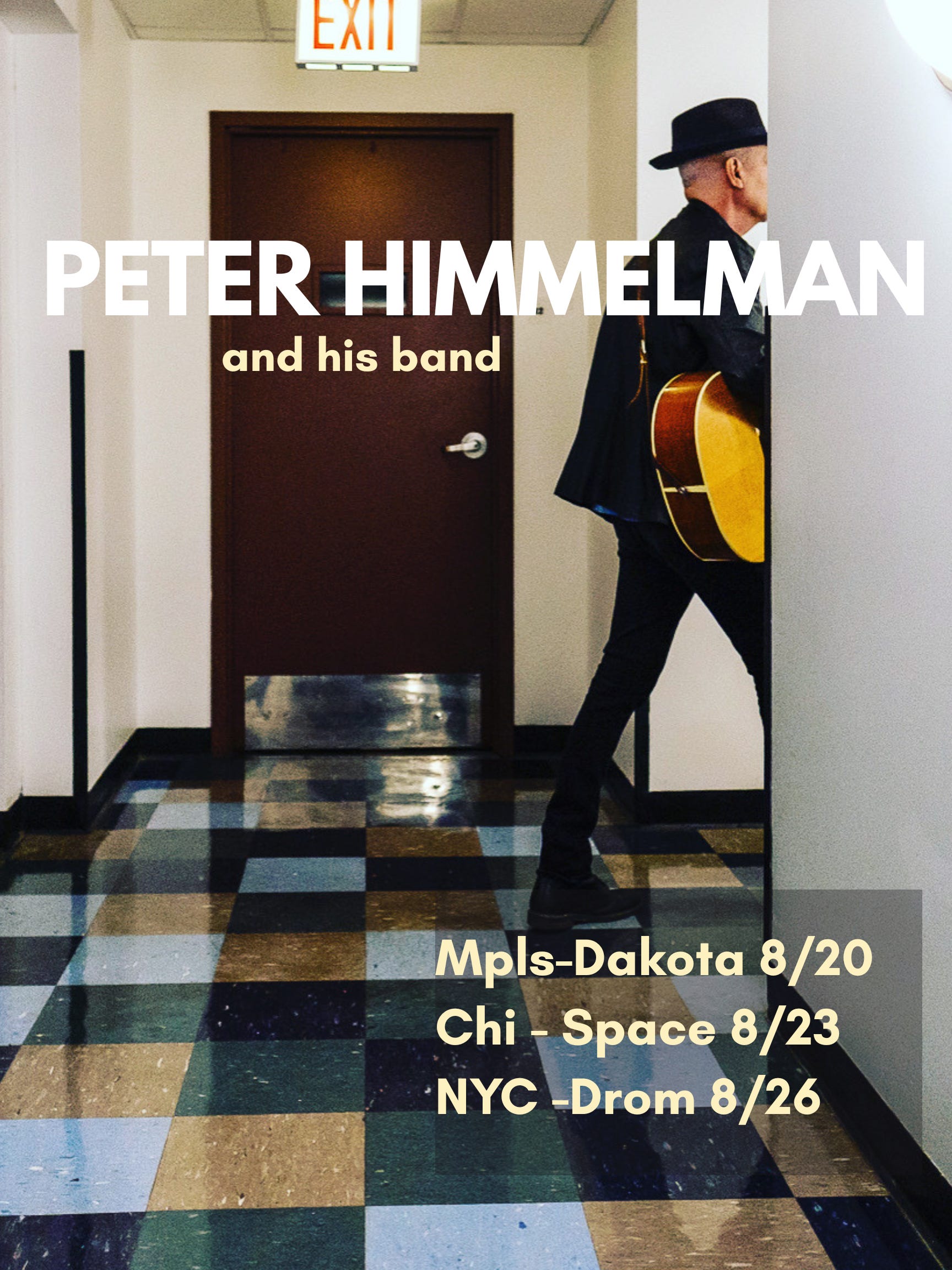
Hi Peter. Always enjoy your musings and often forward them to anri Israel anti semitic on line posters. Still waiting for my first reply. Any chance of streaming these upcoming concerts to subscribers?
I’m loving the art work!