
Duck Arithmetic : Contradiction, Certainty, and the Jewish State
(Essay)

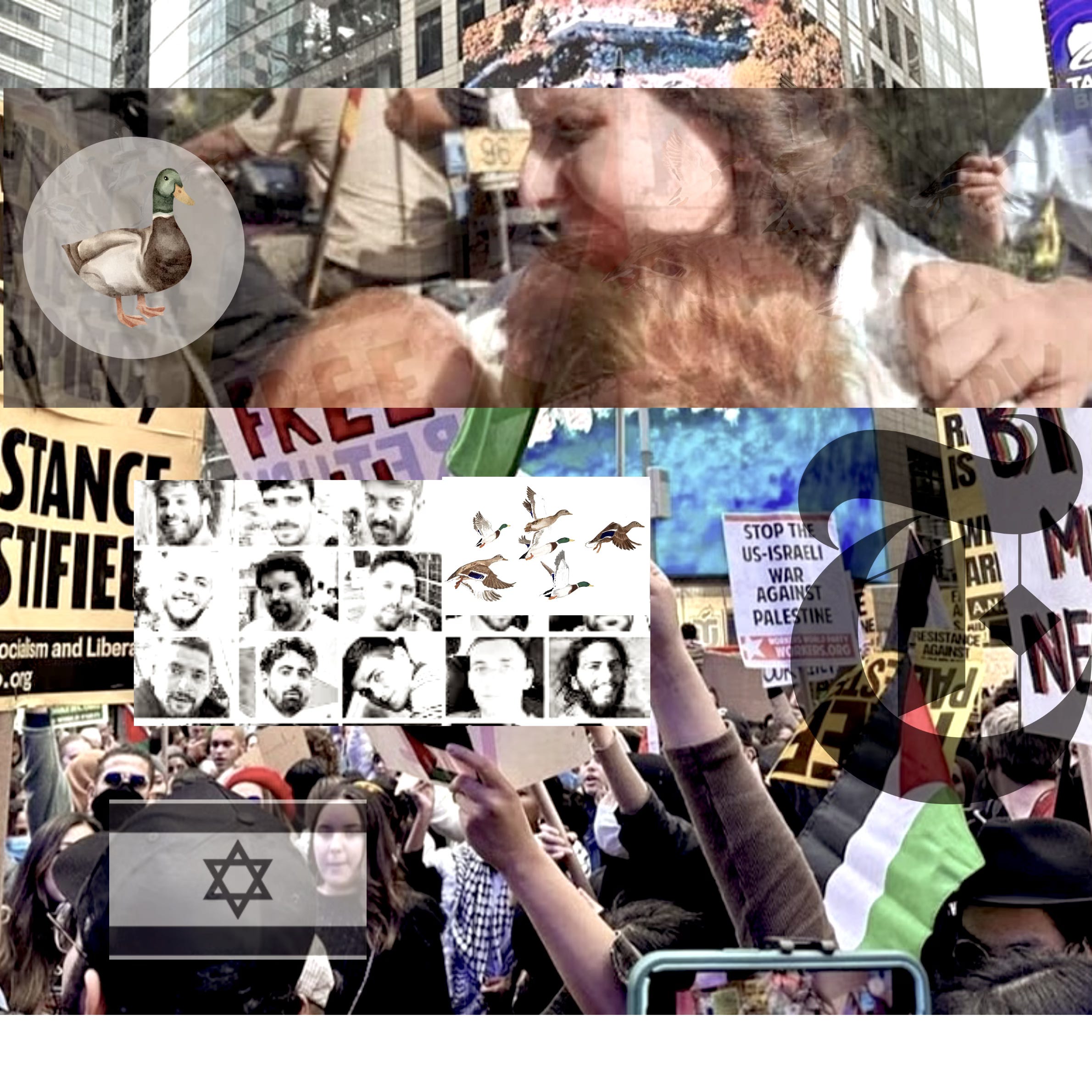
Permit me a brief exercise in arithmetic.
2 + 2 = 4 is true.
2 + 2 = 7 is false.
2 + 2 = a mallard duck is something else entirely.
It’s not just wrong. It’s absurd. A category error. A proposition so detached from ordinary reasoning that rational argument becomes impossible. Increasingly, when discussions turn to Israel, I find we are not dealing in mistaken arithmetic.
We are dealing with ducks.
Legitimate criticism of Israel is not absurd. Scrutiny is not absurd. Nations at war should be scrutinized. Civilian suffering deserves attention. Military decisions deserve examination. None of this is strange.
The question is where scrutiny ends and something else begins.
Take, for example, the recent Nicholas Kristof piece in The New York Times concerning alleged systematic abuse of Palestinian detainees by Israelis. The allegations were grotesque. Almost surreal. Tailor-made for anti-Zionist voices on both the left and right.
The New York Times, among the most powerful journalistic institutions on earth, elevated extraordinary claims, including allegations involving the use of dogs in sexual torture, relying heavily upon anonymous testimony, advocacy organizations, and assertions of corroboration unavailable for public inspection.
Trust us, we’re professionals.
That was, in essence, the request.
Then came the timing.
Kristof’s op-ed appeared just before renewed attention gathered around years of evidence concerning Hamas’s sexual atrocities on October 7 — testimony, forensic evidence, video documentation, legal analysis — and the publication of the exhaustive and deeply disturbing Silenced No More.
The arithmetic felt strange.
Not because allegations against Israelis should be exempt from reporting. But because standards appear strangely elastic. And elasticity is a dangerous variable in moral arithmetic.
The same elasticity appears elsewhere.
Genocide is among the gravest accusations human beings possess. The word implies not merely destruction, death, or terrible war, but intent toward annihilation.
Yet certainty arrives quickly while inconvenient facts drift toward the margins: mass polio vaccination campaigns coordinated during active conflict; hundreds of thousands of doses administered; thousands of aid trucks entering Gaza despite fierce disputes over adequacy, looting, and distribution; warnings preceding some strikes via leaflets, phone calls, text messages, and evacuation orders.
None of these facts absolves. They simply resist simplification. Contradictory evidence should complicate certainty, yet certainty often appears untouched.
Again, the arithmetic morphs into something indiscernible.
Then there is the larger, more vexing puzzle. A nation of roughly ten million people, more than three-quarters of them Jewish, commands extraordinary fixation from international institutions, campuses, activist movements, diplomatic bodies, and media ecosystems. Year after year, the United Nations directs disproportionate condemnation toward Israel compared with states whose abuses are neither hypothetical nor disputed.
China.
Iran.
North Korea.
Syria.
Russia.
The pattern persists.
One may explain it. One may defend it. Still, the disproportionality itself becomes difficult not to notice: the endless resolutions, the encampments, the chants, the masks, the certainty, the obsession.
Alongside these things come reports of Jews murdered, synagogues and Jewish schools firebombed, Jewish students excluded from spaces, intimidated, harassed in the streets and on trains, or told — explicitly or implicitly — that Jewish identity itself has become suspect. Protests against Israel flare up across the globe, many with blatantly anti-Jewish rhetoric, and some with violent motives and manifestations.
Peaceful protest is legitimate. Intimidation is not. Yet distinctions blur with astonishing speed.
One need not be Jewish to ask:
Why this place?
Why these people?
Why always here?
It is possible, of course, that the seven million Jews in Israel and seven million others worldwide possess a uniquely diabolical genius for wrongdoing unmatched in human history.
Or perhaps we are dealing, once again, with the same old absurdist math problem.
The strangest thing is not criticism of Israel.
The strangest thing is the instability of standards — the peculiar way arithmetic shifts, the speed with which contradictions become irrelevant, the confidence with which certainty arrives before inquiry.
At some point, enough impossible equations accumulate.
And one stops arguing numbers.
One begins, instead, to notice ducks.

Criticism of Israel when detached from either context or criticism of others is the third category. Anyone who makes a habit of constantly criticizing Israel (even where deserved) alone is an anti-semite. A good example is the obsession over a small number of settlers that commit violence Judea and Samaria. Of course they are wrong and deserve criticism. And plenty in Israel criticize them and the government for not stopping them. But when people in the West blow up every incident into a major thing and conspicuously avoid criticizing the endless atrocities committed around the world or use an act of wrongsoing to condemn Israel as a whole, they are engaging in anti-semitism.
Another great summary, Peter. Hate is a strong and addictive drug. Selecting someone to blame and hating them is an intoxicating part of the afflictive human condition. An easy high. The N.Y. Times has become an agenda-driven enterprise. Sadly, not the first time. Regarding anything to do with Israel, any notion of a standard of fact-checking and verification-based journalism expertise is in service of a dark and toxic agenda. "Follow the money".